Showing posts with label nyc art. Show all posts

Jul 6, 2014

Fluid Pot of Koreans in NYC: On "KOREA" at FiveMyles

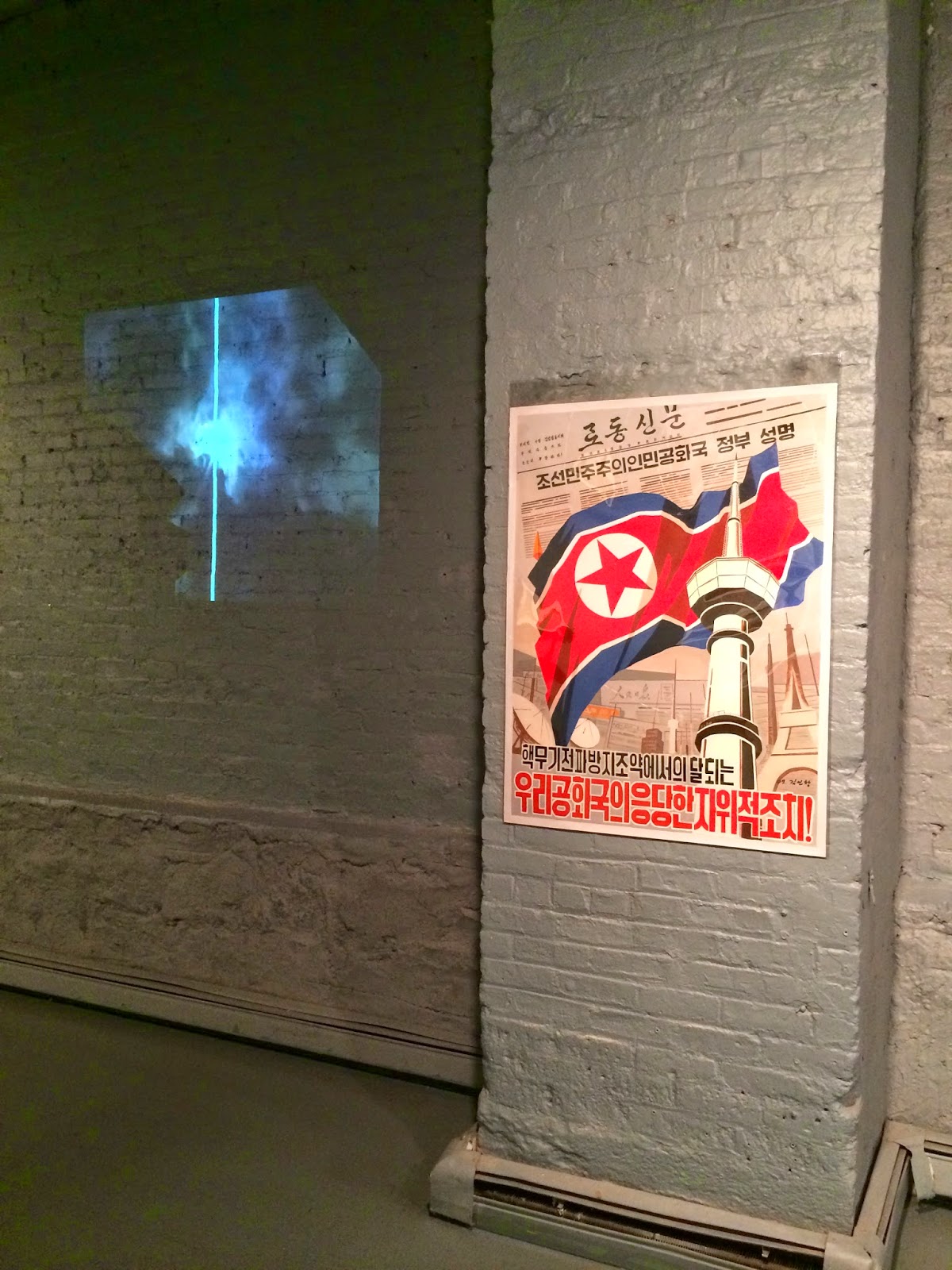
View of Yooah Park's Music Box series (2013) and North Korean posters (from left to right) by Kim In Chang and Ji Jeong Sik.


“KOREA” at FiveMyles Gallery
558 St. John’s Place
Brooklyn, NYC

June 25 – July 13, 2014

            The exhibition simply titled “KOREA,” curated by Han Heng-Gil, is a rare occasion, if not the first here, that has provided an opportunity for New Yorkers to view contemporary works by North and South Korean artists within the same space. Mr. Han has been around the New York City art scene as a curator at The Jamaica Center for Arts & Learning and, over the years, has developed relationships with Korean artists who have both passed through the cultural hub for brief residencies as well as those who have decided to stick around for a longer term. Han occasionally travels back and forth to NYC and South Korea, but the current exhibition at FiveMyles Gallery in Crown Heights, Brooklyn, is the result of a trip the curator recently made to North Korea. He was fortunate to have been able to bring back several paintings by North Korean artists, whose work are on display with those of South Korean as well as Korean American artists.
            Whenever I see an art exhibit as of late, my focus increasingly turns to the curatorial efforts: the way in which the selected art works are displayed as a whole, their flow as overcoming and complicating what the individual works may offer in isolated or otherwise different contexts. Sometimes a curator makes or breaks art works by their arrangements in a given space. My interest in “KOREA” lies in the clear traces of the curator’s hand. When visitors walk into the gallery, the visual divide between the two sides of the space is clear: the two dimensional works along the left side of the space are monochrome, while the works along the right side burst in a clash of vivid colors. In the middle of the floor between the two divides, bronze busts of the former president of South Korea, Lee Myung Bak, and the likewise former ruler of North Korea, Kim Jong-Il, turn around on the floor—just moving in for, or breaking away from, a kiss.

View of SunTek Chung's Me and You, You and Me, 2011 in foreground, projection of Kelvin Kyung Kun Park's Cheonggyecheon Medley (2011) and N. Korean posters (from left to right) by Kim Young Il, Ha Ju Won, and Kim In Chang.

            The bronze work, titled Me and You, You and Me, 2011, is by SunTek Chung, a born-and-raised American. Its position at the center of the space casts a curious light on the nature of the entire show itself: was this convergence of North and South Korean art work—and a critique of North-South relations—only possible by virtue of its locale in New York City, a third-party? NYC serves as the neutral ground (arguably the DMZ in this context) in which the curator (also a “global” citizen in a sense, though South Korean by nationality) is able to articulate a possible utopia or instigate a dialogue about the relationship between two nations whose separation, Mr. Han seems to suggest, have been imposed—and still exist—artificially.
            The installation of the art works indicates the artificiality of the divide between North and South (similarly applicable to East and West, but that is indeed another discussion à la Edward Said). The monochrome side of the exhibit is particularly interesting especially in context of the recent Korean monochrome “trend” as legitimized by exhibitions in “Western” spaces (Alexander Gray Associates in NYC, for one) and the climbing prices for such representative mid- and late-career artists such as (now Guggenheim veteran) Lee Ufan and Park Seo-bo. In contrast, perhaps the nearly intrusive vividness of bright colors on the right side of the gallery may even appear too cheesy and “pop.”

View of the left side of the gallery, including works by Pang In Soo, Kim Tcha Sup, Choi Gye Keun, Choi Il Dan, and Ri Chang.


“KOREA,” however, does not clearly indicate which of the works are by North, South, or Korean American artists. The majestically tacit North Korean monochrome ink paintings hang next to South Korean ones, whereas the display of colorful North Korean propaganda posters from 2007 are interspersed by the equally (if not more) colorful paintings by New York-based Yooah Park and a projection of Cheonggyecheon Medley (2011) by Kelvin Kyung Kun Park, a UCLA and CalArts graduate, who grew up around the world. Kelvin Park’s film portrays South Korean metal shops during the nation’s time of modern development and Yooah Park’s paintings prod at questions about “couples,” but juxtaposed with the propaganda posters, all of their differences melt into a single visual image.

South Korean artist Lee Kakyoung's Window View, 2012

The inclusion of Lee Kakyoung’s video work acts as a humorous visual summary of the almost deceptive melding of the so-called national and cultural divides within the entire exhibition. The work, titled Window View, 2012, is the sole piece placed at a narrow wall adjacent to the monochrome side, only visible when one turns one’s body fully toward the left-hand side. The sneakiest is the work itself: what appears from a distance as a slightly open window penciled onto the surface is actually accompanied by a video projected only onto the open crack of the drawn window. Small people move around busily outside (inside?) this fictional opening.

The best thing about the exhibition, though, is that the visual result achieved by the curatorial efforts overcomes what could have been a cheesy, ideologically propaganda-esque, and utopia-driven project about a “united” Korea. The simultaneous dissonances and resonances offered by the visual selection of works in “KOREA” reaches beyond a singular argument for a possible utopia, but rather opens a dialogue. During my visit, I overheard other visitors argue whether or not the Kelvin Park’s film projection was a North Korean film. We need fresh eyes to look at our world anew in order to change it for the better. I received some hope today that it may still be possible with art.

Mar 25, 2014

On Pop Culture and "Art" + "Blurred Lines"

Brief thoughts about pop culture spilling into “art” and vice versa:

Installation view of The Last Brucennial. Foreground Sculpture: HUSK, 2013 by Parker Shipp, Video:AMERICAN REFLEXXX, 2013 by Alli Coates and Signe Pierce


            Many people have probably witnessed some of the debates about gender equality and representation when the two music videos for Robin Thicke’s “Blurred Lines” came out last year: one with topless women as props, a more PG version with semi-clothed women as props. Either way the women served as props for the men’s videos (nothing new here)—I’ve seen some argue that they can’t believe this sort of blatantly disrespectful sexism is still used (successfully) as a part of popular promotional tactics (are they that surprised?) and others argue that the videos are actually empowering to women because they are so overtly utilizing the device of female sex appeal (I am not too sure about this side of the argument).
           Another related debate resulted after Robin Thicke performed the song with the infamous Miley Cyrus during MTV’s Video Music Awards, where the discussion involved not just the demeaning and destructive double standards of female performers (look at Cyrus, that horrid mess) but also issues of “race” and the ethically questionable appropriation of “black” culture (really nothing new either) by “white” culture. (In my own opinion, the performance was quite offensive, especially because it sought to justify and legitimize a very cookie cutter Disney-turned-trash girl trying to “twerk” by using black female bodies asprops).
            In any case, “Blurred Lines” seems to have come to symbolize (in a relatively short period of time) debates about gender and also race.

Installation view of The Last Brucennial. Top: I FEEL... LOUD, 2014 by Esmeralda Kosmatopoulos, Bottom: Feminist Performance Art, 2013 by Christen Clifford.


           Since then I have seen and heard many references to the debates via simply turning on the song at particular moments—mostly in media, or more casual talk-show or YouTube show-type settings. But recently I’ve been encountering references in “fine art.” One was in AMERICAN REFLEXXX,2013, a video by Alli Coates and Signe Pierce at The Last Brucennial organized by Vito Schnabel and the Bruce High Quality Foundation (great show by the way... if you haven't seen it, see it! Up until April 4th). In that work, a man?, wearing a reflective mask over his face (no features, just a smooth metallic surface) walks around the streets in high heels, a short, tight-fitting dress, and a long blond wig. “Blurred Lines” is creepily slowed down in a nightmarish way as s/he struts through the midst of sometimes quite brutal jeers and insults about how “nasty” it is that a man is walking around like that, dressed as a woman (guesses are made by the size of feet, at one point).
            Another work is Jordan Wolfson’s animatronic sculpture, (Female figure), at David Zwirner Gallery. In this one, a machine wearing a mask, high heels, short, revealing dress, and a long blond wig, dances to a slightly slowed down (equally creepy) excerpt of the song. This “female” wears a mask with features of a goblin, though, and dances against a mirror to which s/he is attached by a (strip club?) pole.
            Clearly, both works use “Blurred Lines” to comment on female sexuality and the meaning/meaninglessness of popular signifiers. I don’t feel like going into detailed analyses of either, but I wanted to make the observation about how quickly the debates in popular culture made its way into aesthetic commentary.

            Or maybe not so quickly, since word/data/info travels so fast now.


            Oh, and… noticing billboard ads around the city for random things, but showing “artists” in their studio against a backdrop of colorful Ab-Ex-type paintings. Or I noticed, during the whole Banksy craze a few months back, ads along this route, but “street artists” standing against colorful graffiti. Big companies’ target audiences now include the billions of “aspiring artists” in metropolises, it seems. And their ads reflect what they think their target audiences think is “good art.” Maybe. Just thoughts…


Mar 21, 2014

RANT on The Whitney Biennial 2014

View of hauntteddd!! n huntteddd!! n daunttlesss!! n shuntteddd!!, 2013 by Charlemagne Palestine. Twelve-channel sound installation on stairwell landings at the Whitney Biennial 2014.

            Some of the biggest mistakes I’ve seen people make about art are judgments and (more unfortunately) entire practices based on empty formalism. My observation is neither a strikingly new revelation nor a particularly contemporary phenomenon, though many art critics have voiced a deal of dissent against the same ol’ same ol’-ness of art nowadays. Making such an observation, however, is important because of how fast information travels now and how “market-oriented” the art world has become (that is, with a more deceptive semblance of a greater inclusiveness of those who are allowed to participate in the game vs. the no non-sense closed-off-ness of monarchical patronage… or something). Because information travels so fast, formal trends easily bleed into ideological, political, and other nuanced concerns; monetary value easily becomes confused with aesthetic, political, philosophical values, and so on. None of these are always very easily distinguishable from each other, but it is important to make an effort to see where one aspect might influence the other and why these occur together now, or then or later, or not at all. It is important to see critically. Sometimes it is easier to consume simply what is fed to you rather than question what it is you are being fed—that is why art and cultural critics are necessary, more than ever now.

            Given the necessity of critical thought in such a fast-paced, info-driven, instant-gratification consumer-demand-driven world (whew), I always find it incredibly disappointing—most of the time infuriating—to witness laziness in a show organized by a major institution. I may not always agree with every aspect of an exhibition put forth by the big names in NYC, but no matter how boring or safe I think a show may be, I rarely think they do not deserve their status. However, I may have experienced my first majorly long lasting feeling of such profound questioning at this year’s Whitney Biennial. Sorry, but no. No no no.

            I will keep this short and simple: the three main floors of the Biennial were jam-packed warehouses of a bunch of “contemporary SHIT” through which I had to sort, with immense effort, so that I could pick out some of the actually good art work. I am sure not all of it was pure shit, but the curatorial work came off lazy and offhanded—the installations were not in any of the works’ favor. Throwing together a bunch of text-based political work in one room (along with maybe 6 other crazy looking STUFF) then a room devoted to Bjarne Melgaard’s godforsaken cocks and penises (can’t leave that bad boy out of this contemporary biennial, can you?), maybe some other weird looking new media installations and videos, recycled ab-ex paintings… Oh and of course throw in some doodles by a dead (white male, now already legendary, oh he was too young) author—nevermind the many many living and talented artists devoting their lives to making real art!


View of hauntteddd!! n huntteddd!! n daunttlesss!! n shuntteddd!!, 2013 by Charlemagne Palestine. Twelve-channel sound installation on stairwell landings at the Whitney Biennial 2014.

           
The best stuff:
     1)  Single Stream (2014) by Pawel Wojtasik, Toby Lee, and Ernst Karel. 23 min single-channel video.
         I may be biased—maybe this has become my new cinematic aesthetic because of A Dream of Iron (2014)—but the visual experience of this work speaks more than words could every fully articulate about trash and recycling, waste, labor, and capitalist, mass-producing, consumerist society. The imagery and sounds are actually quite beautiful—it opens and (almost) closes with a flurry of “snow” (trash) and a pretty twinkling of fairy dust sounds (discarded / sorted metal against metal). The array of colors in an endless stream of WASTE made me hold my breath many times (the sounds and images are slow-mo in parts), like a flow of rare gems or ecstatic confetti, all the way down to the blue aluminum of the Bud light bottles.

     2)   Hauntteddd!!! n huntteddd!! n daunttlesss!! n shuntteddd!!, 2013 by Charlemagne Palestine. Twelve-channel sound installation on stairwell landings.
        Unpretentious, not full of empty shit. It was what it was and did not pretend to be or to do more. It was creepy but cute in a humorously angsty contemporary young art kind of way—walking down the stairs, never-endingly suspenseful old-school horror movie sounds flowed from the speakers installed at every landing, fully decked with its own entourage of stuffed animal/characters—some were Mickey, Hello Kitties, anonymous monkeys and long bits of colorful fabric allowed to hang from the gatherings. The creepy fun-house aspect kept it simple (I think), and the work provided nice breaks from the insane warehouse experience of every floor.

Honorable mention: Untitled (I Was Looking Back To See If You Were Looking Back At Me To See Me Looking Back At You), 2014 by Michel Auder. Three-channel video installation, 15:12 mins.
            A nice experiential rendering of NYC—slow setting moon, visible behind buildings, streams of car lights through dark streets, creepy zoom-in shots of undressing and fucking neighbors. A lot of recognition and familiarity, but too simple? Maybe I need more time with it.

View of Untitled (I Was Looking Back To See If You Were Looking Back At Me To See Me Looking Back At You), 2014 by Michel Auder. Three-channel video installation, 15:12 mins.


            I have also noticed that the ones I picked out as “the best” were allowed relatively isolated locales within the otherwise chaotic biennial. The issue appears to be more of a curatorial one, which is unfortunate, because it throws potentially good work into a large dump of a whole bunch of SHIT (have I said that enough times?). Good work definitely got lost from my eyes, which are bad (deteriorating eye sight, which I often like to moan about) and also impatient (possibly because they are bad). Whether the problem is my own laziness, I feel there is a degree of curatorial responsibility which the Biennial’s organizers failed to uphold—I do not feel very hesitant in questioning the Whitney’s role in placing value on “good” or “hot” or “notable” contemporary art. If we are going to include “trends” inevitably as a part of making such value judgments, going to Volta (or if you want a more bland and established Chelsea route, Armory) will give you a better look at “crazy” and “new” “investible” art than a so-called contemporary art museum. If you’re going to go that way, why bother with a museum? Galleries, art fairs are where the money’s at.

View of Yooah Park's Couples Series Installation at Volta NY 2014.

Feb 13, 2014

shout out to the REAL ART CRITICS

Aftermath of Thomas Albrecht's Performance at Grace Exhibition Space, Body / Mass, Feb 7, 2014
Preliminary remarks:
I decided to forego the no-capitalization policy I have tried very stubbornly to uphold. I wanted to create a more casual and approachable aspect to my writing, and also attempt to eliminate hierarchy that capitalization sometimes bestows on words, concepts, names, etc. But it seemed that the content was as casual or unapproachable to many, as well as just making it difficult to read for those who are not comfortable reading long teenage personal diarrhea on the web.


And the real stuff:

A few recent observations about the “art world” and “artistic discourse”:

1.     No matter where you go, a social community is inevitably social; i.e. there will be hierarchies and dynamics that define the relationships between those involved—creator, distributor, manager, promoter, consumer, etc. etc. but those relationships, depending on the climate of the locale, may be more fluid than others, more open to negotiation and flux.
-       I used to contrast my frustration of feeling “locked out” of the “high art” scene in Venice, Chelsea of NYC, etc etc with the free love of the “community” in the not-so-financially supported Bushwick environment, but people are people and relationships will end up becoming the shitty, standard, fixed, unproductive nonsense that perhaps “art as commodity” has become unless we are aware of it from the beginning and take action to protect what is good about the freedom, the raw energy, the support of people who share common visions, feelings, spirit of a time/generation.
-       Let Bushwick live at the edge of art and gentrification; never let it fall fully into either one…

2.     I made several decisions in the past few years to slowly step out as “creator,” first, from being an object-maker to one who speaks about objects, then to someone who “manages,” helps, induces “creators” and others who speak about objects. So the latter you can throw together a bunch of “professions” such as curator, editor, manager, promoter, and I took the liberty of throwing in there “lawyer,” or at least someone who went to school to learn about boring rules that some old white farts made and keep making, and use that boring shit for purposes that matter to me: art.
-       I keep telling people, it’s OK to run around naked on the street or temporarily “steal” epic art from museums without a permit, I will get them out of jail. I’m not really kidding. Do what you need to do in the name of art, or in the name of shitting on art, and I will do the dirty work of clearing the old white farts out of your way.

Aftermath of Nyugen E. Smith's Performance at Grace Exhibition Space, Body/ Mass, Feb 7, 2014


3.     This is kind of 2.5… But I have sadly rediscovered the importance of CRITICAL art writing—you know, the kind that actually requires thinking and not reading and regurgitating pre-existing material, whether they be theory or press releases.
-       When I was told to write reviews, and when I tried to tell myself to write reviews of art later, I thought my words didn’t matter. The idiots who try very hard to get published will get published and I don’t want to fight with idiots to gain exposure over them because I am too smart for that kind of survival soul-selling bullshit… is what I told myself to make myself feel better about not being able to write a book of philosophy or poetry or new theory on the state of art in OUR generation, since I am still young and all.
-       BUT after removing “art criticism” as a serious obligation from my own plate, I noticed more and more bullshit regurgitation passing as “criticism.” I cannot stand it!

Sadly, what pushed me to the point of this, verbal response, is working on the other side: being a promoter of the creation, and not the “press” or “consumer” or “critic.”

I wrote and edited most of the English-language press kit material for a film recently, including the synopsis and press release.
A review was just published after the film’s screening at Berlin. What do I see? Copy, paste, and rearrangement of what I had written and edited a thousand times in the press kits.

You think I don’t recognize my own words, buddy? Or maybe you think because there is no name on there, a press release just magically appeared. Oh, I guess that’s what you think an “intern” stands for… so many anonymous and over-qualified writers and thinkers working as “interns,” producing promotional texts for “critics” and “journalists” to regurgitate as their own original evaluation of an artist’s work.
Fine.
But to actually recognize someone rearrange MY WORDS, then publish it as a “review” made me realize that, shit, that is what everyone else does all the time.

Geraldo Mercardo Performing at Grace Exhibition Space, Body / Mass, Feb 7, 2014


Where is real art criticism? Where are all the critics, REAL thinkers at?
Stop publishing bullshit, because real thinkers are not damn machines that can churn out real words in real time. Creative thinkers don’t work on Facebook time, Twitter time, or at least in depth anyway. Pay writers for giving thought to their work, not for reproducing bullshit.

Give real writers and thinkers a good chance to contribute to artistic discourse. The kind where relationships happen on a genuine level.

BRING BACK ART CRITICISM!