Jun 18, 2015

Christine Ay Tjoe: Perfect Imperfection

First Type of Stairs (2010), oil on canvas.

My review of Christine Ay Tjoe's solo as it appeared on ArtAsiaPacific:

A curator’s hand can make or break an artist’s work. “Perfect Imperfection,” the first solo exhibition in Korea of prominent Indonesian artist Christine Ay Tjoe, is evidence of one such making. The show reflects the deep understanding the curator has of the artist’s work that is needed to provide an informative framework of her artistic practice and development: from Ay Tjoe’s graphic influences to her beautifully colorful oil canvases. With over 60 works displayed across the three floors of SongEun ArtSpace in Seoul, the exhibition—organized by guest curator Jasmine Prasetio—leads the viewer through the past 15 years of Ay Tjoe’s practice by following the artist’s recurring spiritual metaphors: from darkness and light to somewhere between and within, and also the future. In her body of work, the artist converts Christian biblical references into secularized, spiritual inquiries of universal experiences that we share as human beings.

Jubah Barabas #01 (Barabas' Robe #01) (2008), acrylic on canvas.

The title of the exhibition aptly summarizes Ay Tjoe’s search for the balance between abstraction and figuration, and between control and free flow. The artist’s works are visual representations of her struggle with her own faith and its tension with her undeniable humanness. The painting Jubah Barabas #01 (Barabas’ Robe #01) (2008) exemplifies this constant balancing act, featuring abstract, intertwined figures, in which elements of light and darkness are inextricable linked to one another. Insatiable hands reach out from the obscured, floating bodies—in search of something and with a sense of perpetual longing. The constant strife that arises from the coexistence of our earthly and spiritual desires is perhaps the curse of being human, positioned somewhere between an animal and a transcendent, or an angel and a monster.

Interior / wall view of Journey Without Distance (2011), oil on canvas.

While the theme of insatiable human desires and spiritual transcendence over such worldly attachments pervade much of Ay Tjoe’s work, the artist’s search for a resolution serves as an open conclusion on the last floor of the gallery space. One cannot see the entirety of the large-scale painting Journey Without Distance (2011), because of its proximity to an adjacent wall and the lack of light. Just like how we often go about our everyday without pausing to take in the whole picture of our lives, this expansive painting—suspended from the ceiling and meant to be viewed from a 50-centimeter distance—allows viewers only glimpses of the three-paneled canvas at a time. Viewers must cautiously walk the narrow and dark path between the wall and canvas, following the painting’s soft fields of muted beige gradations, outlined and entangled by the white, red and black lines traced with her signature oil sticks.

The Last Layer (2012), oil on canvas, and video animation projection (2012-14).


The highlight of the exhibition is indisputably The Last Layer (2012), a red-hued painting that hangs isolated in a darkened space partitioned by black curtains. The chapel-like sanctuary achieves maximum effect when the projection of The Last Layer Video Animation (2012–14) spreads outward from the center of the aforementioned painting. The projection shows leafy, red shapes—a recurring motif in Ay Tjoe’s paintings—that turn round and round, like an array of flickering coins gradually spreading out on the floor and ceiling of the gallery space. The effect is mesmerizing: the red canvas appears otherworldly and, for a moment, transports the viewers to a sublime experience. Upon leaving the room, however, one comes to the realization that the search for a resolution is not over, and that our predisposition for inner strife will continue as long as humanity itself.


“Perfect Imperfection” is on view at SongEun ArtSpace, Seoul, until June 20, 2015.

Oct 16, 2014

Absence and Neglect


For some reason
I actually thought that there actually did exist some sort of ontological dispute taking place through or under the guise of an ostensibly linguistic dispute about the definition of art, as manifested by recent lawsuits involving appropriation artists.

Silly me.

It all comes down to money.

Why did I think I could place art in a category that operates differently from others? 
Even though I made conscious and even performatively public criticisms against the infiltration of money into the way in which our cultural products are distributed and legitimized…

For some reason
I thought my discovery of the intersections between law, language, art, philosophy, and other abstract ways in which we understand the world around us was somehow special. Law, especially, because I had never quite understood anything about it until recently.
Art is the same. Money dictates its operations. 

What I had given superficial attention turned out to be a horrible monster, which I am happy I did not endorse so enthusiastically—the rich are winning the copyright litigations and “redefining” the “definition of art”! 

Is this a good thing for art or is it just the victory of those with money?
I can’t tell if it pushes art to go further and into another kind of territory, or if it merely demonstrates the reach of capitalism’s power into a variety of realms such as art and other cultural affairs. 


It feels good to rant again.

But probably another long silence will pass.

Jul 6, 2014

Fluid Pot of Koreans in NYC: On "KOREA" at FiveMyles

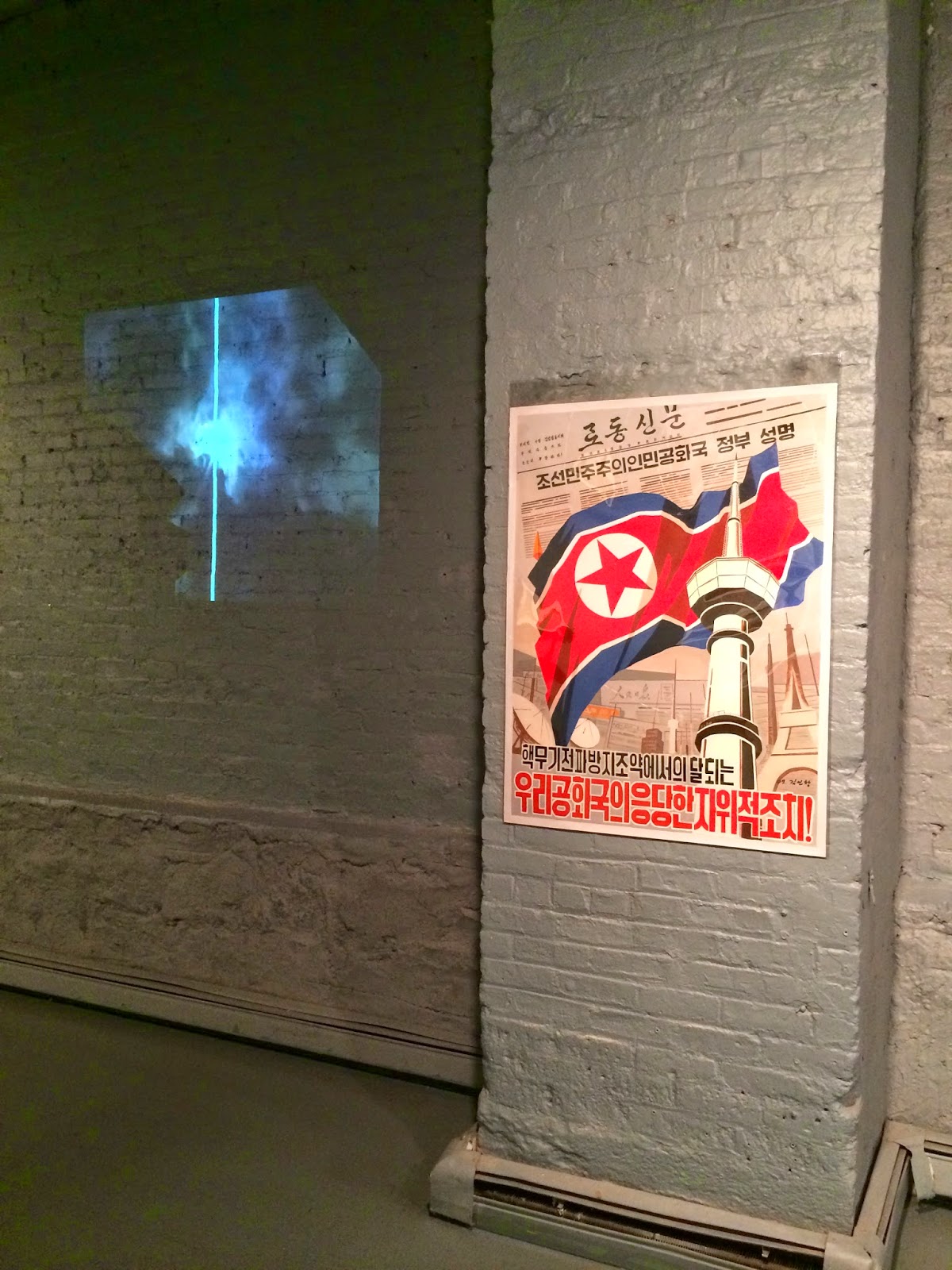
View of Yooah Park's Music Box series (2013) and North Korean posters (from left to right) by Kim In Chang and Ji Jeong Sik.


“KOREA” at FiveMyles Gallery
558 St. John’s Place
Brooklyn, NYC

June 25 – July 13, 2014

            The exhibition simply titled “KOREA,” curated by Han Heng-Gil, is a rare occasion, if not the first here, that has provided an opportunity for New Yorkers to view contemporary works by North and South Korean artists within the same space. Mr. Han has been around the New York City art scene as a curator at The Jamaica Center for Arts & Learning and, over the years, has developed relationships with Korean artists who have both passed through the cultural hub for brief residencies as well as those who have decided to stick around for a longer term. Han occasionally travels back and forth to NYC and South Korea, but the current exhibition at FiveMyles Gallery in Crown Heights, Brooklyn, is the result of a trip the curator recently made to North Korea. He was fortunate to have been able to bring back several paintings by North Korean artists, whose work are on display with those of South Korean as well as Korean American artists.
            Whenever I see an art exhibit as of late, my focus increasingly turns to the curatorial efforts: the way in which the selected art works are displayed as a whole, their flow as overcoming and complicating what the individual works may offer in isolated or otherwise different contexts. Sometimes a curator makes or breaks art works by their arrangements in a given space. My interest in “KOREA” lies in the clear traces of the curator’s hand. When visitors walk into the gallery, the visual divide between the two sides of the space is clear: the two dimensional works along the left side of the space are monochrome, while the works along the right side burst in a clash of vivid colors. In the middle of the floor between the two divides, bronze busts of the former president of South Korea, Lee Myung Bak, and the likewise former ruler of North Korea, Kim Jong-Il, turn around on the floor—just moving in for, or breaking away from, a kiss.

View of SunTek Chung's Me and You, You and Me, 2011 in foreground, projection of Kelvin Kyung Kun Park's Cheonggyecheon Medley (2011) and N. Korean posters (from left to right) by Kim Young Il, Ha Ju Won, and Kim In Chang.

            The bronze work, titled Me and You, You and Me, 2011, is by SunTek Chung, a born-and-raised American. Its position at the center of the space casts a curious light on the nature of the entire show itself: was this convergence of North and South Korean art work—and a critique of North-South relations—only possible by virtue of its locale in New York City, a third-party? NYC serves as the neutral ground (arguably the DMZ in this context) in which the curator (also a “global” citizen in a sense, though South Korean by nationality) is able to articulate a possible utopia or instigate a dialogue about the relationship between two nations whose separation, Mr. Han seems to suggest, have been imposed—and still exist—artificially.
            The installation of the art works indicates the artificiality of the divide between North and South (similarly applicable to East and West, but that is indeed another discussion à la Edward Said). The monochrome side of the exhibit is particularly interesting especially in context of the recent Korean monochrome “trend” as legitimized by exhibitions in “Western” spaces (Alexander Gray Associates in NYC, for one) and the climbing prices for such representative mid- and late-career artists such as (now Guggenheim veteran) Lee Ufan and Park Seo-bo. In contrast, perhaps the nearly intrusive vividness of bright colors on the right side of the gallery may even appear too cheesy and “pop.”

View of the left side of the gallery, including works by Pang In Soo, Kim Tcha Sup, Choi Gye Keun, Choi Il Dan, and Ri Chang.


“KOREA,” however, does not clearly indicate which of the works are by North, South, or Korean American artists. The majestically tacit North Korean monochrome ink paintings hang next to South Korean ones, whereas the display of colorful North Korean propaganda posters from 2007 are interspersed by the equally (if not more) colorful paintings by New York-based Yooah Park and a projection of Cheonggyecheon Medley (2011) by Kelvin Kyung Kun Park, a UCLA and CalArts graduate, who grew up around the world. Kelvin Park’s film portrays South Korean metal shops during the nation’s time of modern development and Yooah Park’s paintings prod at questions about “couples,” but juxtaposed with the propaganda posters, all of their differences melt into a single visual image.

South Korean artist Lee Kakyoung's Window View, 2012

The inclusion of Lee Kakyoung’s video work acts as a humorous visual summary of the almost deceptive melding of the so-called national and cultural divides within the entire exhibition. The work, titled Window View, 2012, is the sole piece placed at a narrow wall adjacent to the monochrome side, only visible when one turns one’s body fully toward the left-hand side. The sneakiest is the work itself: what appears from a distance as a slightly open window penciled onto the surface is actually accompanied by a video projected only onto the open crack of the drawn window. Small people move around busily outside (inside?) this fictional opening.

The best thing about the exhibition, though, is that the visual result achieved by the curatorial efforts overcomes what could have been a cheesy, ideologically propaganda-esque, and utopia-driven project about a “united” Korea. The simultaneous dissonances and resonances offered by the visual selection of works in “KOREA” reaches beyond a singular argument for a possible utopia, but rather opens a dialogue. During my visit, I overheard other visitors argue whether or not the Kelvin Park’s film projection was a North Korean film. We need fresh eyes to look at our world anew in order to change it for the better. I received some hope today that it may still be possible with art.


Jun 10, 2014

Psy Part II: "Hangover" with Snoop Dogg


Let’s get straight to the point.

Initial thoughts:

This new video is interesting for several reasons, but mainly for one: it overturns and/or complicates the arguments about cultural and racial hegemony in my thesis, almost as though it were made in response to the perceived reductivism residing at some points of my reading of the “Gangnam Style” MV.

1.     I previously contributed the appeal or general fascination with the “Gangnam Style” video for a so-called “Western” audience to the silliness of the work. Some of the imagery in the video are semi-neutrally silly—for example, old men jumping agilely as Psy nonchalantly walks away from an unexplained explosion in the background—but the “incomprehensible” nature of the absurd humor contributes partly to (and is fueled by) a pre-existing image of the Asian male (in the American mind) which is deprived an aura of seriousness or sex appeal (unless he is a math or tech wiz, but even then the sex will surely be lacking).
Thus, I argued, Psy “acting the [abject] fool” can appeal across cultures (the fool figure appears in tales and literature of many cultures reaching back to thousands of years ago).
However, his image in the video can be interpreted in a specific way by the pop culture dominants (“Western” media) to serve and perpetuate a pre-existing ideology.
On the other hand, Psy’s utilization of this stardom momentum on an international scale can be perceived as his way of taking advantage of the audience’s consumption of his abject image. In other words, he is not “just” a “fool” but rather a trickster—someone outside of the system who consciously manipulates the system in order to subvert it and/or provide a different perspective of it to others still within it.


2.     The complicating elements of Psy’s new video with Snoop Dogg:
-       Does now my argument about the “in-between” and “sexless” Asian male apply when a legendary, o.g. (black) American rap star participates in the same fooldom with the Asian “coon”? (Oh my, I mentioned African American minstrel shows in my thesis but I surely did not see Snoop coming into the picture). Snoop comes in as one pole of the black-white dichotomy I point to within American discourse on race. The “poles” no longer function the way the white-black dichotomy would—Snoop crosses into a different realm, or perhaps his passage creates this new realm, a vision of a world that is more faithful to our own.
-       Snoop is acknowledged as an undeniable presence in the history of hip-hop for decades through his alliance with other legendary figures. His presence in the MV thus legitimizes Psy as not “just” a ridiculous pop figure easily dismissed. Not only did Snoop Dogg co-produce the song with Psy, but also performs with him. Those from the hip-hop community who previously issued criticisms against “Gangnam Style” that Psy’s music is “not hip hop” may have to reconsider their words post-“Hangover:” Snoop’s presence may elevate Psy from pop to hip-hop or it may simply lower Snoop to the level of Psy’s absurdist abjection. Or they meet somewhere in the middle.
-       Snoop participates with Psy in the drunken escapades, but he is undeniably the “outsider” in a video that refers very specifically to a Korean drinking culture—the soju, the noraebang (Korean karaoke in private rooms), etc. His difference is not only racial and cultural, but also physically, the guy is visibly taller than all of the other (Korean) figures who appear in the video (best seen when Snoop, Psy, and two women are skipping along together).
But I don’t feel from watching the video that Snoop is “out of place.” He is Psy’s buddy. (Made me think of this).

Perhaps the smooth blending points to a greater, more ideal Bakhtinian festive utopia than was proposed by “Gangnam Style.” No longer a one-sided proposition / performance but a collaboration—I am surprised how well the Psy-Snoop combo turned out.


3.     Certain things that still remain:
-       Humor and masculinity are still at the expense of female subjugation and their roles as sexual props. Their presence as props appear even heightened in the new video—choreography during the saxophone part is starkly sexual, but not quite, in my opinion, overtly so enough to merit attention as a self-reflexive criticism of misogyny.
-       In some scenes—such as the Psy-swimming-Snoop-robed one—Psy plays the more “abject” role, but understandably so: even if Snoop is willing to collaborate with a guy who has developed an international reputation based on a silly video, the rapper has a long history of a “serious” image as a seasoned hip-hoper. (+ Psy as Bruce Lee...)

My thoughts for now.

(In conclusion, I LOVE IT.)

Oh, and the appearance by 2NE1’s CL is much appreciated (I am a huge and shameless fan).


Mar 25, 2014

On Pop Culture and "Art" + "Blurred Lines"

Brief thoughts about pop culture spilling into “art” and vice versa:

Installation view of The Last Brucennial. Foreground Sculpture: HUSK, 2013 by Parker Shipp, Video:AMERICAN REFLEXXX, 2013 by Alli Coates and Signe Pierce


            Many people have probably witnessed some of the debates about gender equality and representation when the two music videos for Robin Thicke’s “Blurred Lines” came out last year: one with topless women as props, a more PG version with semi-clothed women as props. Either way the women served as props for the men’s videos (nothing new here)—I’ve seen some argue that they can’t believe this sort of blatantly disrespectful sexism is still used (successfully) as a part of popular promotional tactics (are they that surprised?) and others argue that the videos are actually empowering to women because they are so overtly utilizing the device of female sex appeal (I am not too sure about this side of the argument).
           Another related debate resulted after Robin Thicke performed the song with the infamous Miley Cyrus during MTV’s Video Music Awards, where the discussion involved not just the demeaning and destructive double standards of female performers (look at Cyrus, that horrid mess) but also issues of “race” and the ethically questionable appropriation of “black” culture (really nothing new either) by “white” culture. (In my own opinion, the performance was quite offensive, especially because it sought to justify and legitimize a very cookie cutter Disney-turned-trash girl trying to “twerk” by using black female bodies asprops).
            In any case, “Blurred Lines” seems to have come to symbolize (in a relatively short period of time) debates about gender and also race.

Installation view of The Last Brucennial. Top: I FEEL... LOUD, 2014 by Esmeralda Kosmatopoulos, Bottom: Feminist Performance Art, 2013 by Christen Clifford.


           Since then I have seen and heard many references to the debates via simply turning on the song at particular moments—mostly in media, or more casual talk-show or YouTube show-type settings. But recently I’ve been encountering references in “fine art.” One was in AMERICAN REFLEXXX,2013, a video by Alli Coates and Signe Pierce at The Last Brucennial organized by Vito Schnabel and the Bruce High Quality Foundation (great show by the way... if you haven't seen it, see it! Up until April 4th). In that work, a man?, wearing a reflective mask over his face (no features, just a smooth metallic surface) walks around the streets in high heels, a short, tight-fitting dress, and a long blond wig. “Blurred Lines” is creepily slowed down in a nightmarish way as s/he struts through the midst of sometimes quite brutal jeers and insults about how “nasty” it is that a man is walking around like that, dressed as a woman (guesses are made by the size of feet, at one point).
            Another work is Jordan Wolfson’s animatronic sculpture, (Female figure), at David Zwirner Gallery. In this one, a machine wearing a mask, high heels, short, revealing dress, and a long blond wig, dances to a slightly slowed down (equally creepy) excerpt of the song. This “female” wears a mask with features of a goblin, though, and dances against a mirror to which s/he is attached by a (strip club?) pole.
            Clearly, both works use “Blurred Lines” to comment on female sexuality and the meaning/meaninglessness of popular signifiers. I don’t feel like going into detailed analyses of either, but I wanted to make the observation about how quickly the debates in popular culture made its way into aesthetic commentary.

            Or maybe not so quickly, since word/data/info travels so fast now.


            Oh, and… noticing billboard ads around the city for random things, but showing “artists” in their studio against a backdrop of colorful Ab-Ex-type paintings. Or I noticed, during the whole Banksy craze a few months back, ads along this route, but “street artists” standing against colorful graffiti. Big companies’ target audiences now include the billions of “aspiring artists” in metropolises, it seems. And their ads reflect what they think their target audiences think is “good art.” Maybe. Just thoughts…